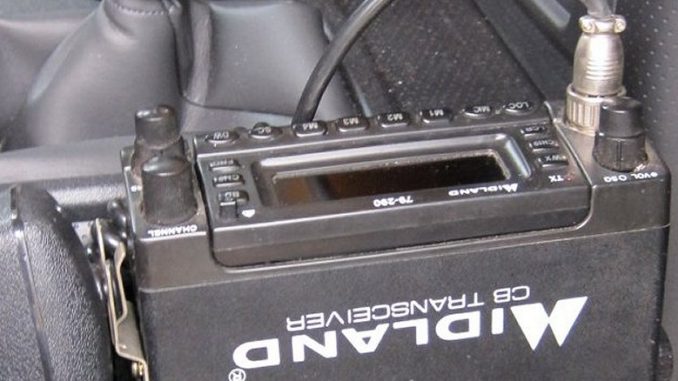
 Citizens’ Band radio (often shortened to CB radio) is, in many countries, a system of short-distance radio communications between individuals on a selection of 40 channels within the 27-MHz (11 m) band. The CB radio service is distinct from FRS, GMRS, MURS, or amateur (“ham”) radio. In many countries, CB does not require a license and, unlike amateur radio, it may be used for business as well as personal communications. Like many other two-way radio services, Citizens’ Band channels are shared by many users. Only one station may transmit at a time. Other stations must listen and wait for the shared channel to be available.
Over time, several countries have created similar radio services, with varying requirements for licensing and differing technical standards. While they may be known by other names, such as General Radio Service in Canada, they often use similar frequencies (26 to 28 MHz), and have similar uses, and similar difficulties with antennas and propagation. Licenses may or may not be required, but eligibility is generally simple.
 Some countries have personal radio services in the UHF band, such as the European PMR446 and the Australian UHF CB. Like the American FRS and GMRS services, these are more properly covered in their own articles, as much of this article is specific to the antenna and propagation of the upper HF and lower VHF bands.
Origins of Citizens’ Band radio
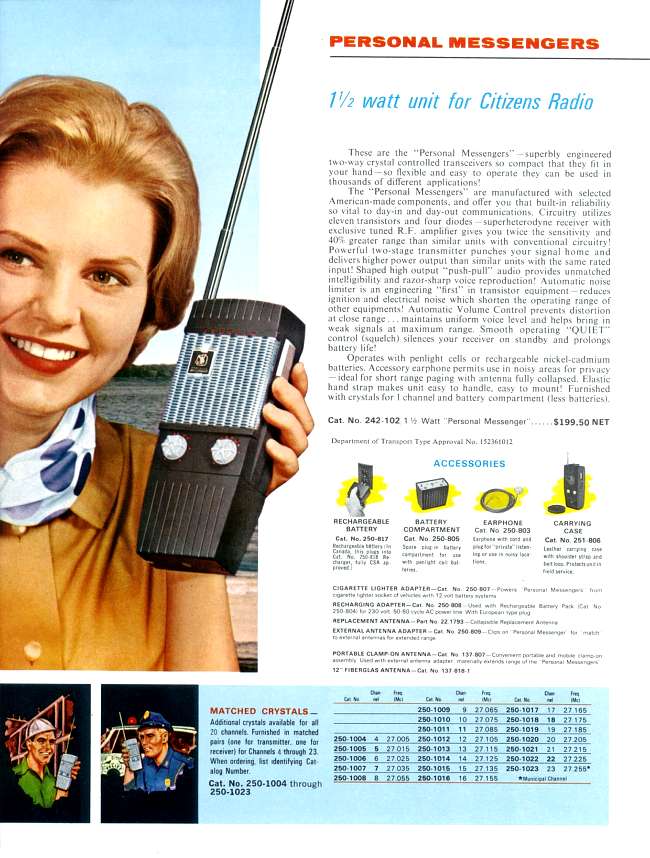
The Citizens’ Band radio service originated in the United States as one of several personal radio services regulated by the FCC. These services began in 1945 to permit citizens a radio band for personal communication (e.g., radio controlled models, family communications, individual businesses). Originally, CB Radios operated on the 460 MHz–470 MHz UHF band. There were two classes of CB: A and B. Class B radios had simpler technical requirements but were limited to a smaller range of frequencies. Al Gross, inventor of the walkie-talkie, started Citizen’s Radio Corp. in the late 1940s to merchandise Class B handhelds for the general public.
The technology at the time was not advanced enough for UHF radios to be practical and affordable for the average consumer. So, in 1958, the Class D CB service was opened at 27 MHz, and this is what is popularly known as CB. There were only 23 channels at the time; the first 22 were taken from what used to be an Amateur 11-meter band, while channel 23 was shared with radio-controlled devices. Some hobbyists continue to use the designation “11 meters” to refer to the Citizens’ Band and adjoining frequencies.
Most of the 460 MHz–470 MHz band was reassigned for business and public safety uses, but Class A CB is the ancestor of the present General Mobile Radio Service GMRS. Class B, in the same vein, is a more distant ancestor of the Family Radio Service. The Multi-Use Radio Service is another two-way radio service, in the VHF high band. An unsuccessful petition was made in 1973 to create a Class E CB service at 220 MHz, this was opposed by amateur radio organizations and others. There are several other classes of personal radio services for specialized purposes such as remote control devices.
In the 1960s, the service was popular with small trade businesses (e.g., electricians, plumbers, carpenters), as well as truck drivers and radio hobbyists. With the advancement of solid-state electronics, the weight, size, and cost of the radios decreased, giving the general public access to a communications medium that had previously been only available to specialists. Many CB clubs were formed, and a special CB slang language evolved, used alongside 10-codes similar to those used in the emergency services.
Growing popularity in the 1970’s
Following the 1973 oil crisis, the U.S. government imposed a nationwide 55 mph speed limit, and fuel shortages and rationing were widespread. CB radio was often used to locate service stations with a supply of gasoline, to notify other drivers of speed traps, and to organize blockades and convoys in a 1974 strike protesting the new speed limit and other trucking regulations. Throughout the 1970s and early 1980s, a phenomenon was developing over the CB radio. Similar to the Internet chat rooms a quarter century later, the CB allowed people to get to know one another in a quasi-anonymous manner. Many movies and stories about CBers and the culture on-the-air developed.
The prominent use of CB radios in 1970s-era films such as Smokey and the Bandit (1977), Convoy (1978), and television shows like Movin’ On (debuted 1974) and The Dukes of Hazzard (debuted 1979) bolstered the appeal of CB radio. Moreover, popular novelty songs such as C.W. McCall’s Convoy (1976) helped establish CB radio as a nationwide craze in the USA in the mid- to late-1970s.
| CB Radio’s Made Popular by the Big Screen Smokey and the Bandit is a 1977 movie starring Burt Reynolds, Sally Field, Jackie Gleason, Jerry Reed, Pat McCormick, Paul Williams, and Mike Henry. It inspired several other trucking films, including two sequels, Smokey and the Bandit II (originally known as Smokey and the Bandit Ride Again in the U.K.), and Smokey and the Bandit Part 3. There were also a series of 1994 television movies (Bandit Goes Country, Bandit Bandit, Beauty and the Bandit and Bandit’s Silver Angel) from original director/writer Hal Needham loosely based on the earlier version, with actor Brian Bloom now playing Bandit. The three original movies introduced two generations of the Pontiac Trans Am (while the TV-movie version drives the Dodge Stealth). The film was the second highest grossing film of 1977, beaten only by Star Wars. |
| Convoy is a 1978 action film directed by Sam Peckinpah and starring Kris Kristofferson, Ali MacGraw, Ernest Borgnine and Burt Young. Convoy was based on the 1975 country and western and novelty song “Convoy” by C.W. McCall. It is considered the premier example of the CB Radio/trucker film genre which rose to prominence in the 1970s following the success of Smokey and the Bandit, White Line Fever and the television series Movin’ On. |
Originally, CB required a license and the use of a call sign, but when the CB craze was at its peak, many people ignored this requirement and used made-up nicknames or “handles”. The many restrictions on the authorized use of CB radio led to widespread disregard of the regulations, most notably in antenna height, distance restriction for communications, licensing and the use of call signs, and allowable transmitter power. Eventually, the license requirement was dropped entirely.
Originally, there were only 23 CB channels in the U.S.; the present 40-channel bandplan did not come along until 1977. Channel 9 was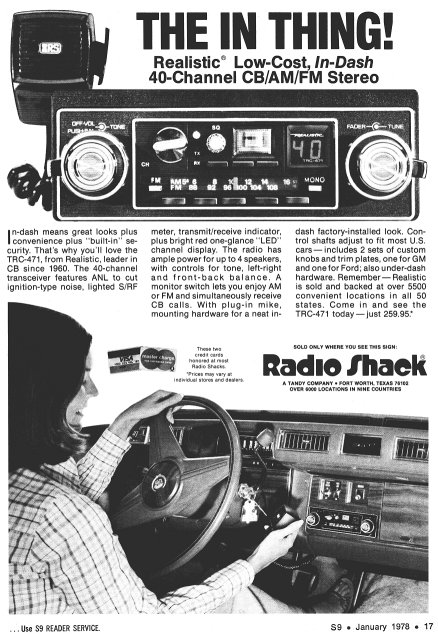 reserved for emergency use in 1969. Channel 10 was used for highway communications, though channel 19 later became the preferred highway channel in most areas as it did not have adjacent-channel interference problems with channel 9.
Until 1975, only channels 9–14 and 23 could be used for “interstation” calls to other licensees. Channels 1–8 and 15–22 were reserved for “intrastation” communications among units under the same license. After the interstation/intrastation rule was dropped, channel 11 was reserved as a calling frequency for the sole purpose of establishing communications; however this was withdrawn in 1977.
In more recent years, CB has lost much of its original appeal due to the advancement of technologies and changing values. Some of this rapid development includes: mobile phones, the Internet, and Family Radio Service. The changing radio wave propagation for long-distance communications, due to the 11 year sunspot cycle, is always a factor for these frequencies. In addition, CB in some respects became a victim of its own intense popularity. Because of the millions of users jamming onto frequencies during the mid-to-late 1970s and early 1980s, channels often were intolerably noisy and communication became difficult. Many CBers started to use their radios less frequently or not at all after this period.
Australia
Before CB was authorized in Australia, there were hand held 27 MHz “walkie-talkies” that utilized several frequencies in between the present CB channels, such as 27.240 MHz. By the mid-1970s, hobbyists were experimenting with these handheld radios, as well as with unauthorized American CB radios. At that time in Australia, the 11-meter band was still used by licensed ham operators but not yet available for CB-type use.
A number of CB clubs had formed by this time, which assigned callsigns to members, exchanged QSL cards, and lobbied for the legalization 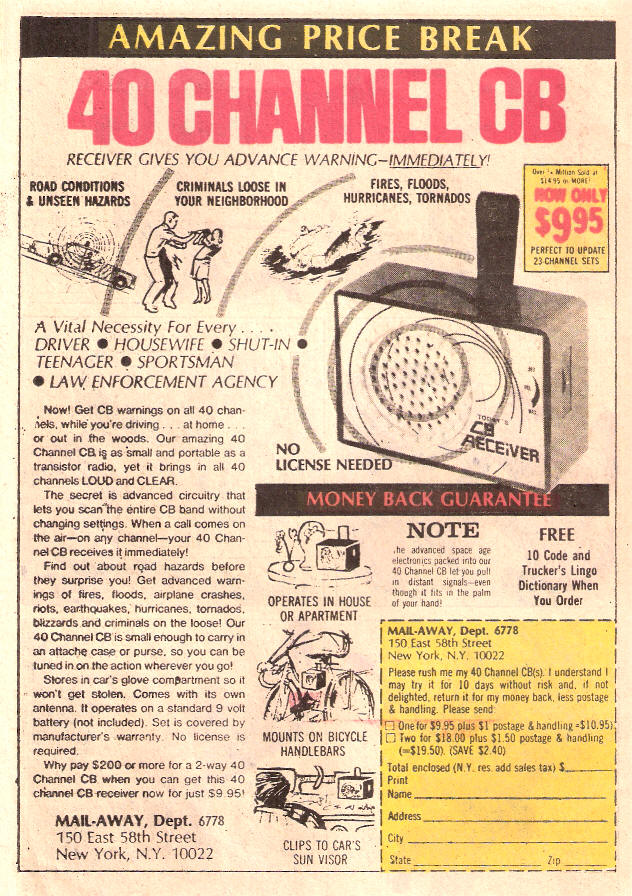 of CB. In 1977, CB was legalized with an 18-channel bandplan. Later, in 1980, the American 40-channel bandplan was adopted. From the outset, the Government attempted to regulate CB radio with license fees and call-signs etc, but some years later abandoned this approach.
The first CB club in Australia was the Charlie Brown Touring Car Club (CBTCC), which formed in Morwell, Victoria in 1967 and consisted of members who were mainly four-wheel drive enthusiasts. The club used the prefix GL (for Gippsland) due to the fact that “CB” could not be used. After July 1, 1977, the club changed its name to Citizens Band Two Way Communication Club (CBTCC). Other early clubs were the LV (Latrobe Valley) and the WB named after Wayne Britain. Members of these clubs are still about and have also become amateur radio operators.
With the introduction of UHF CB radios in 1977, many operators used both UHF and HF radios and formed groups to own and operate local FM repeaters.
Members of the CBTCC formed what became known as Australian Citizens Radio Movement (ACRM) in the early 1970s and this organization became the mouthpiece for CB radio legalization throughout Australia.
After peaking in the 1970s and early 1980s, the use of 27 MHz CB in Australia has fallen dramatically in the last decade. The later introduction of 477 MHz UHF CB, with FM and repeaters, and the proliferation of cheap, compact handheld UHF transceivers have been part of the reason. But other technologies such as mobile telephones and the Internet have provided people with other choices for communications.
Canada
In Canada, the “General Radio Service” has the identical frequencies and modes as the United States “Citizen’s band”, and no special provisions are required for either Canadians or Americans using CB gear while traveling across the border.
The General Radio Service was authorized in 1962. Initially CB channels 1 through 3 remained allocated to amateur radio and channel 23 was used by paging services. American CB licensees were initially required to apply for a temporary license to operate in Canada. In April 1977 the service was expanded to the same 40 channels as the American service.
Indonesia
In Indonesia, CB radios were first introduced around 1977 when some transceivers were imported illegally from Australia, Japan and the United States. The dates are hard to confirm accurately but certainly early use was known around big cities such as Jakarta, Bandung, Yogyakarta, Surabaya and Medan.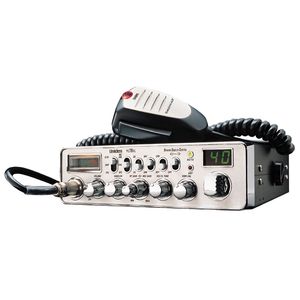
The Indonesian government legalized CB on October 6, 1980 through a decision of the Minister of Communications called the Ministerial Decree on the Licensing for the Operation of Inter-Citizens Radio Communication. Because many people were already using 40-channel radios prior to legalization, the American bandplan, with AM and SSB, was adopted; a VHF band was added later in 1994. On November 10, 1980, the Indonesian Directorate General of Posts and Telecommunications issued another decree establishing RAPI (Radio Antar Penduduk Indonesia) as the official citizens band radio organization in Indonesia.
United Kingdom
In Great Britain, some people were illegally using American CB radios in the 1970s. The prominence of CB radio grew in Britain partly due to the popularity of novelty songs like CW McCall’s “Convoy” and Laurie Lingo & The Dipsticks’ “Convoy GB” in 1976 (both of which were Top 5 hits), and then the film Convoy in 1978. By 1980, CB radio had become a popular pastime in Britain, however, as late as the summer of 1981, the British government was still saying that CB would never be legalized on 27 MHz, and proposed a UHF service around 860 MHz called “Open Channel” instead.
However, in November 1981, and after high profile public demonstrations, 40 frequencies unique to the UK, known as the 27/81 Bandplan, and using FM, were allocated at 27 MHz, plus 20 channels on 934 MHz (934.0125 to 934.9625 MHz with 50-kHz-spacing). CB’s inventor Al Gross made the ceremonial first legal British CB call from Trafalgar Square, London. The maximum power allowable on 27/81 was 4 watts, in common with the American system, although initially the set had to be equipped with a facility to reduce the output to a mere 0.4 watts if the antenna was mounted more than 7 metres above ground level! That rule was (thankfully) relaxed fairly quickly, although the power reduction switch could still prove useful in cases of TV interference.
Later, the UK added the more usual 40 frequencies used worldwide for a total of 80 channels at 27 MHz, and the 934 MHz band was withdrawn in 1998.
CB radio in the UK was deregulated in December 2006 by the regulatory body Ofcom, and CB radio in the UK is now license-free. The old 27/81 band will not be withdrawn from service in the near future and will continue to be available for the foreseeable future.
The rules regarding non-approved radios, modes other than FM, and power levels above 4 watts still apply, regardless of the deregulation. Anyone using illegal equipment or accessories is still running the risk of prosecution, fines, and/or confiscation of equipment.
Although the use of CB radios in the UK is limited, it is still popular, especially with the farming community and Mini-Cab services. The widely accepted channel for the Young Farmers Club is Channel 11.
CB frequencies worldwide
Similar radio services exist in many countries around the world. Frequencies, power levels, and modes (such as FM, AM and SSB) may vary from country to country, and usage of foreign equipment may be illegal. However, many countries have adopted the American frequencies.
In Europe, the CEPT adopted the North American channel assignments, except that FM is used instead of AM. Some member countries permit additional modes and frequencies. Germany also has 40 unique channels at 26 MHz for a total of 80. Before CEPT, most of the member countries used some subset of the 40 USA channels.
In Poland (and probably some other former Warsaw Pact countries) the channels are shifted 5 kHz down, so for example channel 30 is 27.300 MHz, many operators add a switch that can change between the “zeroes” (the Polish channel assignment), and the “fives” (the international assignment).
New Zealand and Japan have unique allocations that don’t correspond to any other country.
Indonesia has the usual 40 channels at 27 MHz, plus a unique 60-channel allocation from 142.050 MHz–143.525 MHz.
Using radios outside their intended market can be dangerous as well as illegal. For example, the British frequencies clash with a radio service used by ambulance services in Ukraine.
CB Radio today
CB was once the only practical two-way radio system for the individual consumer, and as such served several distinct types of users such as truck drivers, radio hobbyists, and those who needed a short-range radio for particular tasks. While some of these users have moved on to other radio services, CB is still a popular hobby in many countries. In the United States it is strongly associated with semi truck drivers and rural life.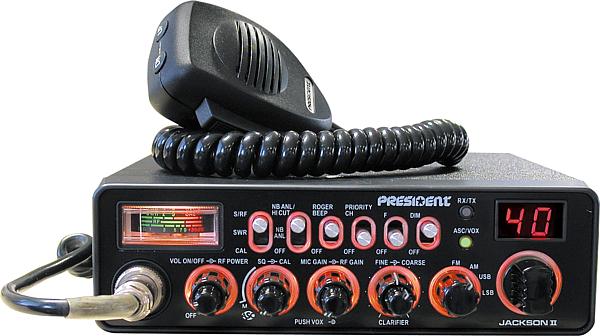
The 27-MHz-frequencies used by CBs, which require a long antenna and don’t propagate well indoors, tend to discourage use of handheld radios for many applications. Many consumer users of handheld radios (ex. family use, hunters, hikers) have moved on to 49 MHz and then to the UHF Family Radio Service, while many who need a simple radio for professional use (ex. tradesmen) have moved on to “dot-color” business radios.
On the other hand, CB is still popular among long-haul truck drivers to communicate directions, traffic problems, and other things of importance. This has long been the case in the United States, but less so in Europe where until recently conflicting regulations made it impossible for the same radio to be used across Europe. As a result, CB in Europe became more associated with hobbyists than with truckers.
Legitimate, short-range use of CB radio is sometimes made difficult by users of illegal high-power transmitters, which are capable of being heard hundreds of miles away. In the United States, the vast number of users and the low financing of the regulatory body mean that the regulations are only actively enforced against the most severe interfering stations, which makes legitimate operations on the Citizen’s band unreliable.
The maximum legal CB power output level, in the U.S., is four watts for AM and 12 watts (peak envelope power or “PEP”) for SSB, as 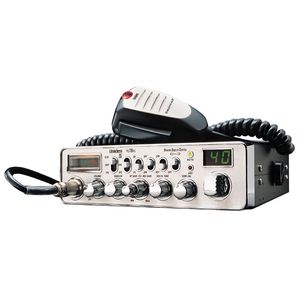 measured at the antenna connection on the back of the radio. However, illegal external linear amplifiers are frequently used. In the 1970s the FCC banned the sale of linear amplifiers capable of operation from 24 to 35 MHz to discourage their use on the CB band, though the use of high power amplifiers by lawless operators continued. Late in 2006 the FCC amended the regulation to only exclude 26 to 28 MHz. Extremely lax enforcement of these regulations by the FCC has led to manufacturers of illegal linear amplifiers (such as Fat Boy) openly advertising their products for sale, and many CB dealers carry these and other amplifiers in their product lines and include them in catalogs.
Shooting skip
All frequencies in the HF spectrum (3–30 MHz) can be refracted by charged electrons in the ionosphere. Refracting signals off the ionosphere is called skywave propagation; the operator is said to be “shooting skip”. CB operators have communicated across thousands of miles, sometimes around the world, making initial contact on the internationally recognized calling frequency (27.555 MHz), then moving to another frequency. Even low-powered 27 MHz transmitters can sometimes transmit over long distances.
The ability of the ionosphere to bounce signals back to earth is caused by radiation from the sun. The amount of ionization possible is related to the 11-year sunspot cycle. In times of high sunspot activity, the band can remain open to much of the world for long periods of time. During low sunspot activity, it might not be possible to shoot skip at all except during periods of sporadic electron propagation, which occur from late spring through mid-summer. Skip contributes to noise on CB frequencies.
In the United States, it is illegal to engage in, or attempt to engage in, CB communications with any station more than 250 km (150 miles) from an operator’s location. This restriction exists to keep CB as a local radio service. The legality of shooting skip is not an issue in most other countries.
CB antennas
As 27 MHz is a relatively long wavelength for mobile communications, and as with all radio systems, the choice of antenna has a considerable impact on the performance of a CB radio.
One common mobile antenna is a quarter-wave vertical whip. This is roughly nine feet (2.7 m) tall and mounted low on the vehicle body, and often has a spring and ball mount to enhance its resilience to scraping and striking overhead objects.
Where a nine-foot whip would be impractical, shorter antennas include loading coils to make the antenna electrically longer than it actually is. The loading coil may be on the bottom, middle, or top of the antenna, while some antennas are wound in a continuously loaded helix.
Many truckers use two co-phased antennas mounted on their mirrors. Such an array is intended to enhance performance to the front and back, while reducing it to the sides, a desirable pattern for long-haul truckers. However, the efficiency of such an arrangement is only an improvement over a single antenna when the co-phased antennas are separated by approximately eight feet or more, restricting this design to use mainly on tractor trailers and some full-size pickups and SUVs. Some operators will use only one of the antennas in the pair; this removes both the complexity and benefit of a true co-phased array but gives a symmetrical cosmetic appearance that some truck drivers prefer.
Another mobile antenna is the continuously-loaded half-wave antenna. These do not necessarily require a ground plane to present a near 50 Ohm load to the radio, and are often used on fiberglass vehicles such as snowmobiles or boats. They are also ideal for base station usage where the circumstances preclude the use of an antenna that requires a ground plane to function properly.
Handheld CBs often use either a telescoping center-loaded whip, or a continuously-loaded “rubber ducky” antenna.
Base CB antennas may be vertical for omnidirectional coverage, or directional “beam” antennas may be used to direct communications to a particular region. “Ground Plane” kits exist as a mounting base for typical mobile whips, and have several wire terminals or hardwired ground radials attached. These kits are designed to have a mobile whip screwed on top (again, the full-length steel whip is a preferred candidate) and mounted on top of a mast. The ground radials take the place of the vehicle body, which is used as a counterpoise for the mobile whip in a typical vehicle installation.

Very interesting column. I received my first CB License in 1968. Call sign KNP8868.
Since then I have enjoyed the band very much! Use it always on long road trips.