Offroaders.com Guide to Tire Terminology. Whether you are sizing up your next Mud Tire or buying new tires for your trailer, a guide to understanding the terms used in the tire industry will help you make an educated decision. This guide defines commonly used tire terms including tread and construction related definitions, size and rating related terms as well as general tire terminology.
Tire Terminology
All Terrain Tires
All Terrains – All Terrain tires or AT are a compromise. All Terrains are an attempt to offer good performance both on road as well as offroad. The ALL TERRAIN TREAD is intended to performs well under a variety of conditions found offroad while still offering acceptable on-highway performance. This is accomplished by using a tread pattern design where the lugs are tighter together than a more aggressive mud tire’s tread. The result is usually a quieter ride on the street than a mud tire due to its lesser aggressive tread pattern. When compared to a street tire, All Terrain tires usually produce more noise. The payoff of an All Terrain Tire is that they performs well on a variety of terrains: rocks, sand, somewhat in the mud while still offering decent traction on the paved road. One drawback of an all terrain is that the tread design tends to pack with mud however some of the AT designs perform surprisingly well in muddy conditions. The AT All Terrain is typically the tire for the 4-wheeler who drives their 4×4 as a daily driver and will see minimal trail use and more on highway driving.
Mud Terrain Tires
Mud Terrain Tires – MUD TIRES or MT (Mud Terrain) are as you might have gathered from the name, designed to perform most specifically in the mud. But when you look at the tread design of many mud tires, they generally perform well in other conditions such as on the rocks, in deeper snow, as well as in loose gravel and in the softer, constantly changing terrain of wooded trails. This is because mud tires are usually designed from a softer compound with wider gaps (voids) between the lugs, which grab onto anything it can hook one of its lug edges around, especially when aired down. Tread designs typically are what make or break a mud tire and vary widely from manufacturer to manufacturer. Drawbacks of the MT Mud Terrain tire are they perform poorly on the highway especially in the rain where the wide lug pattern results in less of a tire footprint on the road. Even worse, the MT can be downright dangerous in icy conditions. Mud tires also tend to wear quicker than an all terrain or a street tire and depending on your perspective, the on-highway noise level can be considerably higher especially after they wear down with highway use.
Bias-Ply Tires and Radial Tires
There are two basic types of tire construction that mud, all terrain and street tires use as their foundation. They are bias-ply and radial designs. Each type of tire construction has its own unique set of characteristics that are the key to its performance, whether on road or off road and these characteristics can help to define the purpose of the tire. The following information will explain what identifies the difference between a bias ply tire and a radial type tire.
BIAS PLY Tire
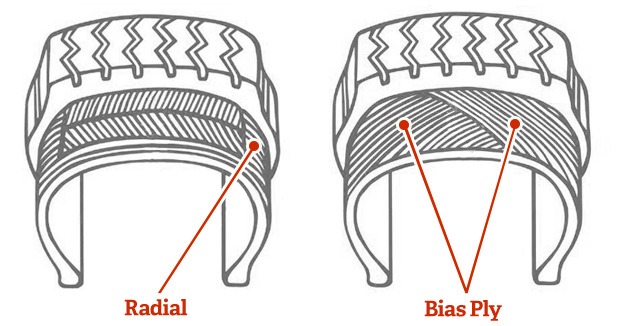
The simple definition of a Bias Ply Tire: The bias ply tire construction utilizing rubber-coated layers known as plies composed of textile cords, usually nylon and sometimes Kevlar. The plies layered diagonal from one bead to the other bead at about a 30 degree angle. One ply is set on a bias in one direction as succeeding plies are set alternately in opposing directions as they cross each other and the ends are wrapped around the bead wires, anchoring them to the rim of the wheel. The layers of plies are them covered with more rubber to form the tread of the tire. Bias ply tires are sometimes called cross-ply tires.
Performance and Purpose of a Bias Ply
Bias ply tires have a limited purpose in life and are only used for specific purposes or jobs. The reason for this is because of its performance characteristics. However for some jobs the bias ply tire is an idea tire for the purpose such as for the tires of a towed trailer, farm equipment tires, some purpose built tires like extreme terrain tires and some forms of racing still use bias ply tires. The reasons for this limited use are:
- The bias-ply tire casing is constructed to form one working unit. When the sidewalls deflect or bend under load, the tread squeezes in and distorts. The distortion affects the tires footprint and can decrease traction and increases wear depending on the terrain. The tread distortion also causes abrasion from the ground surface, which reduces the life of the tire. These factors are why bias ply tires are not idea for passenger car tires or as tires that my see highway use unless used as tires for a towed trailer.
- Bias Ply Strength – The way to increase the strength of bias-ply tires is by increasing the number of plies and bead wires. More plies means more mass which, increasing heat retention and reducing tire life.
- Because of the bias ply inherent construction, sidewall strength is less than that of a radial tire’s construction and cornering is significantly less effective. This is probably one of the main reasons bias ply tires are not used for passenger cars and trucks.
- However because of the bias ply construction and inherent strength of a properly inflated tire, the bias ply is idea for straight line towing.
RADIAL Tire
The simple definition of a Radial type tire: The radial is a type of tire that is constructed with rubber coated, reinforcing steel cable belts that are assembled parallel and run from side to side, bead to bead at an angle of 90 degrees to the circumferential centerline of the tire. (As opposed to the 30 degree alternating application lengthwise as in bias ply tires). This makes the tire more flexible which reduces rolling resistance to improve fuel economy. Then numerous rubber coated steel belts are then constructed into the “crown” of the tire under the tread to form a strong stable two-stage unit.
Performance and purpose of Radial tires
Radial tires are the preferred tire of choice in most applications for several key reasons.
- The combination of steel stabilizing belts in the single-layer radial casing allows the tread and sidewall to act independently. The sidewall flexes more easily under the weight of the vehicle and its cargo, while the tank-track type tread provides even contact with the ground. Greater vertical deflection is achieved with radial tires. This is desirable because extreme flexing greatly increases resistance to punctures.
- To increase a radial tire’s strength, larger diameter steel cables are used. Larger steel cables can help reduce punctures, tears and flats. Larger steel cables also help distribute heat, resulting in a cooler running tire and improving fuel economy. Unlike bias ply tires larger steel cables have little negative affect on performance.
- The parallel stabilizing steel belts of the radial minimize tread distortion. As the sidewalls flexes under load, the belts hold the tread firmly and evenly on the ground or object and thus minimizing tread scrub and greatly increasing tread life.
- When cornering the independent action of the tread and sidewalls keeps the tread flat on the road. This allows the tire to hold to its path.
- When offroad, the radial tire’s stabilizing steel belt design aids in greater traction by holding the tread evenly over obstacles allowing the tread of the tire to have a better chance of finding traction.
Back to the top
What are Sipes?
Sipes are the small slots that are cut or molded into a tire tread surface. These slots are meant to aid in increasing traction in snow, ice, mud, and wet road surfaces. The name of the concept of siping a tire comes from a man named John Sipe, who received a patent in the 1920’s, after realizing that an array of small transverse cuts in the heels of his shoes gave him better traction. Later Goodyear received a US patent claiming that the “sipes” improved traction characteristics in tires.
Tire tread is a series of block shapes, groove configurations, and sipes, all of which have an affect on the tires traction and noise level. Typically, wide, straight grooves running in the direction that the tire travels will have a lower noise level and good water removal. More lateral grooves running from side to side will usually increase traction while increasing noise levels. Sipes are the small grooves or slits that are cut across larger tread elements. Up to a point, more sipes give more traction in snow and mud as well as over various terrains found offroad.
Reading a Tire:
All tires are required to have certain information molded into the side of the tire in a location known as the sidewall. Some of the information is self explanatory while other information requires a little knowledge to decipher. The following will help you understand what this information means.
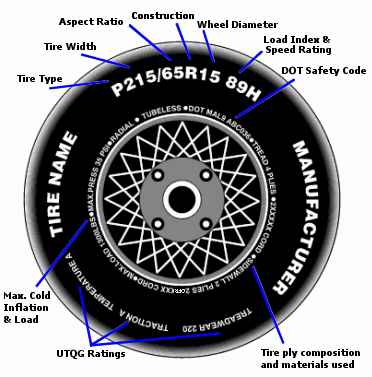
Tire Type – This Defines the intended proper use of the tire. P indicates this is a passenger car tire while LT indicates the tire would be for a light truck with a heavier load rating.
Tire Width – This is the width of the tire measured in millimeters from sidewall to sidewall. An example might be 215 representing 215 millimeters.
Aspect Ratio – This is the the ratio of the height of the tire’s cross-section to its width. An example of this might be 65, which means that the height is equal to 65% of the tire’s width. To calculate the aspect ratio, multiple the first number (e.g. 215) by the second number with a decimal before the number (e.g. .65). Using the example numbers the tires aspect ratio would calculate as 215x.65=139.75 where 139.75 is the tires height in millimeters. This is the height of the rubber from rim to tread on one side of the tire.
To convert the aspect ratio to a full tire height in inches, do this:
Convert the above calculated tire height (aspect ratio) in millimeters to inches by multiplying the millimeters by .03937 (139.75 x .03937 = 5.5 inches). Then take the inches and multiply by two and add the rim size. Example: 5.5 x 2 + 15 (rim size in inches) = a 26 inch tall tire.
Construction – This indicates how the how the tire was put together and will say much about the tires handling characteristics. R indicates the tire is a radial type tire. For more information about what a radial is, click here. B indicates the tire is a bias ply type tire. For more information about bias ply type tires, click here.
Wheel Diameter – This is the width of the opening in the tire where it would be mounted to a wheel. This is measured from one bead across the opening to the other side of the same bead. This measurement is in inches and an example would be 15 and indicates that this tire is for a 15 inch rim, or wheel.
Load Index – This is a number corresponds to the maximum load in pounds that a tire can support when properly inflated. You will also find the maximum load in pounds and in kilograms molded elsewhere on the tire sidewall.
| Tire Load Ranges | Inflation Pressure Assigned For “Maximum Load” Ratings | |
|---|---|---|
| P-metric | ||
| Standard Load | (SL) | 35 psi |
| Extra Load | (XL) | 41 psi |
| Light Truck | ||
| Load Range C | (LRC) | 50 psi |
| Load Range D | (LRD) | 65 psi |
| Load Range E | (LRE) | 80 psi |
Speed Rating – This is a number that corresponds to the maximum service speed for a tire. See Chart for ratings. Note: Speed ratings are specific for passenger car tires and not light truck tires. Light truck tires (LT) are not speed rated.
Rating | Maximum Speed |
| Q | 99 mph |
| S | 112 mph |
| T | 118 mph |
| U | 124 mph |
| H | 130 mph |
| V | 149 mph |
| W | 168 mph |
| Y | 186 mph |
| Z | Above 149 mph |
Disclaimer for the common sense challenged: Please note that this rating relates only to tire speed capability based on tire tires limits, and is NOT a recommendation to exceed legally posted speed limits; always drive within the legal speed limits. | |
PSI — Pounds per square inch – used to measure air pressure in a tire. The PSI rating on tires is typically the maximum recommended tire pressure for that tire. Tire pressure should always be checked periodically and when the tires are cold. Under normal operation, tires can lose approximately 1 PSI of pressure every month. For every 10 degree change in ambient temperature, tire pressure can change by approximately 1 PSI.
DOT – This means the tire is compliant with all applicable safety standards established by the U.S. Department of Transportation (DOT). Adjacent to this is a tire identification or serial number; a combination of numbers and letters with up to 12 digits.
UTQG – This stands for Uniform Tire Quality Grading, which is a quality rating system developed by the Department of Transportation (DOT).
The DOT requires the manufacturers to grade passenger car tires based on three performance factors: tread wear, traction, and temperature resistance. Note: snow tires are exempt from the UTOG rating system.
Tread Wear
Greater than
100 Better 100 Baseline Less than
100 Poorer The tread wear grade is a comparative rating based on the wear rate of the tire when tested under controlled conditions on a specified government test track. A tire graded 200 would wear twice as long on the government test track as one graded 100. Your actual tire mileage depends upon the conditions on which they are used and will vary with driving habits, service practices (alignments, proper air pressure, etc), differences in road characteristics and climate. Note: Tread wear grades are valid only for comparisons within a manufacturer’s product line. They are not valid for comparisons between manufacturers.
Traction
A Best B Intermediate C Acceptable Traction grades represent the tire’s ability to stop on wet pavement as measured under controlled conditions on specified government test surfaces of asphalt and concrete. The Traction grade is based upon “straight ahead” braking tests; it does not indicate cornering ability.
Temperature
A Best B Intermediate C Acceptable The temperature grades represent the tire’s resistance to the generation of heat when tested under controlled conditions on a specified indoor laboratory test wheel. Sustained high temperatures can cause the materials of the tire to degenerate and thus reduce tire life. Excessive temperatures can lead to tire failure. Federal law requires that all tires meet at least the minimal requirements of Grade C.
Light Truck Sidewall Designations
Light truck size designation using aspect ratio
LT 255/85B16
- LT = Light truck tire
- 255 = Approximate cross section width in millimeters
- 85 = Aspect ratio (height to width)
- B = Bias ply construction (R = Radial construction)
- 16 = Rim diameter in inches
Light truck size designation using inches
33×12.50R15 LT
- 33 = Approximate diameter in inches
- 12.50 = Approximate cross section width in inches
- R = Radial construction (B = bias ply construction)
- 15 = Rim diameter in inches
- LT = Light truck tire
Tire Components
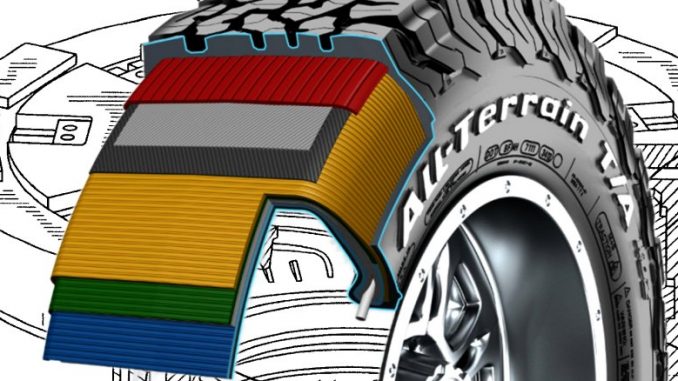
Belts — One or more rubber-coated plies (layers) of steel, polyester, nylon, Kevlar or other material running circumferentially around the tire under the tread. They are designed to reinforce body plies to hold the tread flat on the road. Belts reduce squirm to improve tread wear and resist damage from impacts and penetration.
Carcass (Casing) — The main body of the tire consisting of wire beads and body plies. The carcass does not including the tread or sidewall rubber.
Inner Liner — A layer of specially compounded rubber forming the inside of a tubeless tire, designed to inhibit loss of air pressure.
Plus Sizing — Plus Sizing is among the simplest ways for you to dramatically improve both the look and performance of your vehicle. The concept is to alter the wheel diameter and the tire aspect ratio. There are three common categories of Plus Sizing: Plus Zero, Plus One and Plus Two. One or two layers of heat and impact resistant, rubber-coated fabric used to form the body of the tire. Automobile and light truck tire plies are normally constructed of nylon or polyester cords.
Ply — One or two layers of heat and impact resistant, rubber-coated fabric used to form the body of the tire. Automobile and light truck tire plies are normally constructed of nylon or polyester cords.
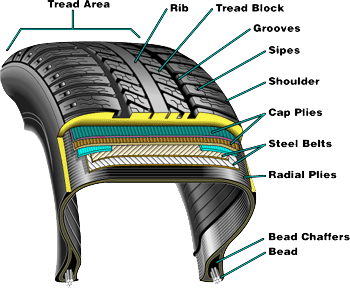
Tread — The portion of the tire which comes in contact with the road. Tread designs vary widely depending the the specific purpose of the tire.
Tread Groove — The space or area between two tread rows or blocks.
Tread Design — The Pattern of Grooves and Tread Elements
Tread Pattern, Lugs, Voids — The tread pattern refers to the overall structure of the tread. The tread pattern is made up of tread lugs and tread voids. The lugs are the sections of rubber that make contact with the terrain. Voids are the spaces that are located between the lugs. The mud-terrain tire pattern is characterized by large lugs in the tread pattern with large voids between these lugs. The large lugs provide plenty of bite in poor traction conditions while the large voids allow the tire to clean itself (Self Cleaning) by releasing and expelling the mud or other material while spinning. The all-terrain tire pattern is characterized by smaller voids and lugs when compared to the mud terrain tire. A denser pattern of lugs and smaller voids make all terrains quieter on the street than the mud terrain tire. The downside to an all terrain is that the smaller voids cannot clean themselves as easily of mud, slush or material as would the larger voids on the mud tire. When voids fill up with mud the tire loses much of it’s bite and traction. However the all terrain is a good compromise to general highway driving and minimal off-road use.
Self Cleaning — Self Cleaning is the effect of a tire’s tread pattern to allow the release of mud or material from the voids of tread, thereby providing a good bite on every rotation of the tire. The better mud terrain tires will allow the mud or material to easily be released from the tread voids.
Asymmetrical Tread Design, Non-symmetrical design – The design of the tread pattern changes from one side of the tread face to the other, in order to have two or more different types of tread patterns on one tire for better overall performance.
Directional Tread Design — A tire designed to rotate in only one direction for maximum performance, especially on wet roads or in mud.
Sidewall Strength — Sidewall strength refers to the tires resistance to punctures and tears in its sides. The strength is typically a result of the number plys extending into the sidewall and by the tread design and tread pattern that extends down onto the sidewalls. Typically the greater the sidewall strength, the more resistant the tire is to flex even when aired down to lower pressures.
Mud & Snow Tread Design — A tire with a heavy bar or block tread element design to provide maximum traction in mud or snow conditions. The tire will be marked M+S or MT on the sidewall.
Non-Directional Tread Design — A tire designed to rotate in either direction without loss in performance.
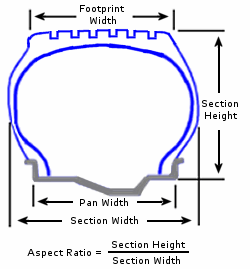
Aspect Ratio — A numerical term which expresses the relationship between the section height of the tire and the cross section width. The lower the aspect ratio, the wider the tread and the shorter the sidewall.
Hydroplaning — Associated with driving on rain-slicked roads with worn or poorly treaded tires. It is the lifting action on a tire when water pressure forces the tire upward, leaving a cushion of water between the tire and road surface.
Load Range — A term which is gradually replacing the term “Ply Rating” and which is indicated as Standard Load (SL) and Extra Load (XL) for auto tires and Load Range C, D etc. for light truck tires. (The carrying capacity of the tire at specific air inflation pressures.)
Service Description — A marking consisting of the load index and speed symbol, ie. 87S.
Tread Depth — A mound of rubber in the tread measured in 32nds of an inch from the tread surface to the bottom of the tread grooves.
Tread Design — The pattern of grooves and tread elements.
Tread Wear Indicator — Narrow bars of rubber molded into the tread at a height of 2/32nds of an inch. When wear reaches the tread wear indicator, it is time to replace the tire.
Wheel Alignment — The measuring, analyzing, and setting of angles to predetermined manufacturer recommended specifications to ensure maximum tire service life, vehicle handling, and safety. Proper wheel alignment is attained when each wheel’s position, relative to the vehicle and specification, is correct.
Four-Wheel Alignment — Four-wheel alignment is the setting of all four wheels to specifications and referenced to the vehicle centerline.
Two-Wheel Alignment — Two-wheel alignment is normally performed on solid axle rear wheel drive vehicles, and is the setting of the front wheels relative to one another.
Wheel Balancing — Adding external weights to compensate for unequal distribution of tire and wheel weight. Unbalanced tire and wheel assembly is balanced by clamping appropriate metal weight to the rim.

WHAT DOES THE X/T STAND FOR ON A TIRE?