
Offroaders.com Guide to P-Metric Tire Sizes, Conversion Chart and Tire Terminology – P-Metric to Inches
| Rim Size | P-Metric Size | Tread Width | Actual Tire Height |
| 15 Inch | 205/70R15 | 8.0 inches | 26.3 inches |
| 215/75R15 | 8.46 inches | 27.7 inches | |
| 235/75R15 | 9.25 inches | 28.9 inches | |
| 265/70R15 | 10.4 inches | 29.6 inches | |
| 16 Inch | 225/75R16 | 8.8 inches | 29.3 inches |
| 235/85R16 | 9.25 inches | 31.7 inches | |
| 245/75R16 | 9.6 inches | 30.5 inches | |
| 265/70R16 | 10.4 inches | 30.6 inches | |
| 265/75R16 | 10.4 inches | 31.6 inches | |
| 285/75R16 | 11.2 inches | 32.8 inches | |
| 305/70R16 | 12.0 inches | 32.8 inches | |
| 315/75R16 | 12.4 inches | 34.6 inches | |
| 345/75R16 | 13.6 inches | 36.4 inches | |
| 17 Inch | 235/65R17 | 9.25 inches | 29.0 inches |
| 245/70R17 | 9.6 inches | 30.5 inches | |
| 255/75R17 | 10.0 inches | 32.0 inches | |
| 255/80R17 | 10.0 inches | 33.0 inches | |
| 265/70R17 | 10.4 inches | 31.6 inches | |
| 275/70R17 | 10.8 inches | 32.2 inches | |
| 285/70R17 | 11.2 inches | 32.7 inches | |
| 285/75R17 | 11.2 inches | 33.8 inches | |
| 305/65R17 | 12.0 inches | 32.6 inches | |
| 315/70R17 | 12.4 inches | 34.4 inches | |
| 18 Inch | 265/60R18 | 10.4 inches | 30.5 inches |
| 275/65R18 | 10.8 inches | 32.1 inches | |
| 275/70R18 | 10.8 inches | 33.2 inches | |
| 285/75R18 | 11.2 inches | 34.8 inches | |
| 295/65R18 | 12.6 inches | 33.1 inches | |
| 305/60R18 | 12.0 inches | 32.4 inches | |
| 305/70R18 | 12.0 inches | 34.8 inches | |
| 20 Inch | 275/60R20 | 10.8 inches | 33.0 inches |
| 275/65R20 | 10.8 inches | 34.0 inches | |
| 285/60R20 | 11.2 inches | 33.4 inches | |
| 285/65R20 | 11.2 inches | 34.5 inches | |
| 295/55R20 | 12.6 inches | 32.8 inches | |
| 295/60R20 | 11.6 inches | 33.9 inches | |
| 305/55R20 | 12.0 inches | 33.2 inches | |
| 325/60R20 | 12.8 inches | 35.3 inches |
▪ Convert P-Metric Tire to Inches
▪ Ring Pinion and Gear Ratio
▪ Speedometer Converter
▪ Find new Gear Ratio with new Tire Size
▪ Find Overall Crawl Ratio
▪ Find MPH
▪ Find RPM
▪ Convert P-Metric Tire to Inches
Reading a Tire:
All tires are required to have certain information molded into the side of the tire in a location known as the sidewall. Some of the information is self explanatory while other information requires a little knowledge to decipher. The following will help you understand what this information means.
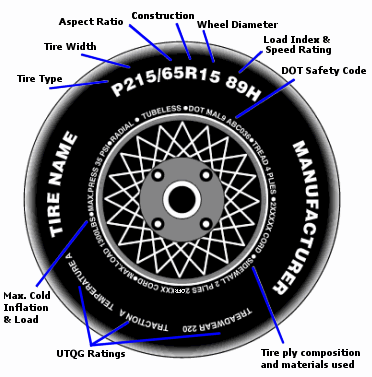
Tire Type – This Defines the intended proper use of the tire. P indicates this is a passenger car tire while LT indicates the tire would be for a light truck with a heavier load rating.
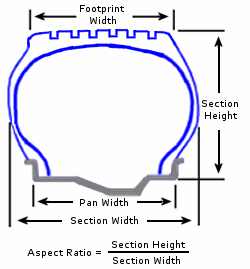
Tire Width – This is the width of the tire measured in millimeters from sidewall to sidewall. An example might be 215 representing 215 millimeters.
Aspect Ratio – This is the ratio of the height of the tire’s cross-section to its width. An example of this might be 65, which means that the height is equal to 65% of the tire’s width. To calculate the aspect ratio, multiple the first number (e.g. 215) by the second number with a decimal before the number (e.g. .65). Using the example numbers the tires aspect ratio would calculate as 215x.65=139.75 where 139.75 is the tires height in millimeters. This is the height of the rubber from rim to tread on one side of the tire.
To convert the aspect ratio to a full tire height in inches, do this:
Convert the above calculated tire height (aspect ratio) in millimeters to inches by multiplying the millimeters by .03937 (139.75 x .03937 = 5.5 inches). Then take the inches and multiply by two and add the rim size. Example: 5.5 x 2 + 15 (rim size in inches) = a 26 inch tall tire.
Construction – This indicates how the how the tire was put together and will say much about the tires handling characteristics. R indicates the tire is a radial type tire. For more information about what a radial is, click here. B indicates the tire is a bias ply type tire. For more information about bias ply type tires, click here.
Wheel Diameter – This is the width of the opening in the tire where it would be mounted to a wheel. This is measured from one bead across the opening to the other side of the same bead. This measurement is in inches and an example would be 15 and indicates that this tire is for a 15 inch rim, or wheel.
Load Index – This is a number corresponds to the maximum load in pounds that a tire can support when properly inflated. You will also find the maximum load in pounds and in kilograms molded elsewhere on the tire sidewall.
Speed Rating – This is a number that corresponds to the maximum service speed for a tire. See Chart for ratings. Note: Speed ratings are specific for passenger car tires and not light truck tires. Light truck tires (LT) are not speed rated.
Rating | Maximum Speed |
| Q | 99 mph |
| S | 112 mph |
| T | 118 mph |
| U | 124 mph |
| H | 130 mph |
| V | 149 mph |
| W | 168 mph |
| Y | 186 mph |
| Z | Above 149 mph |