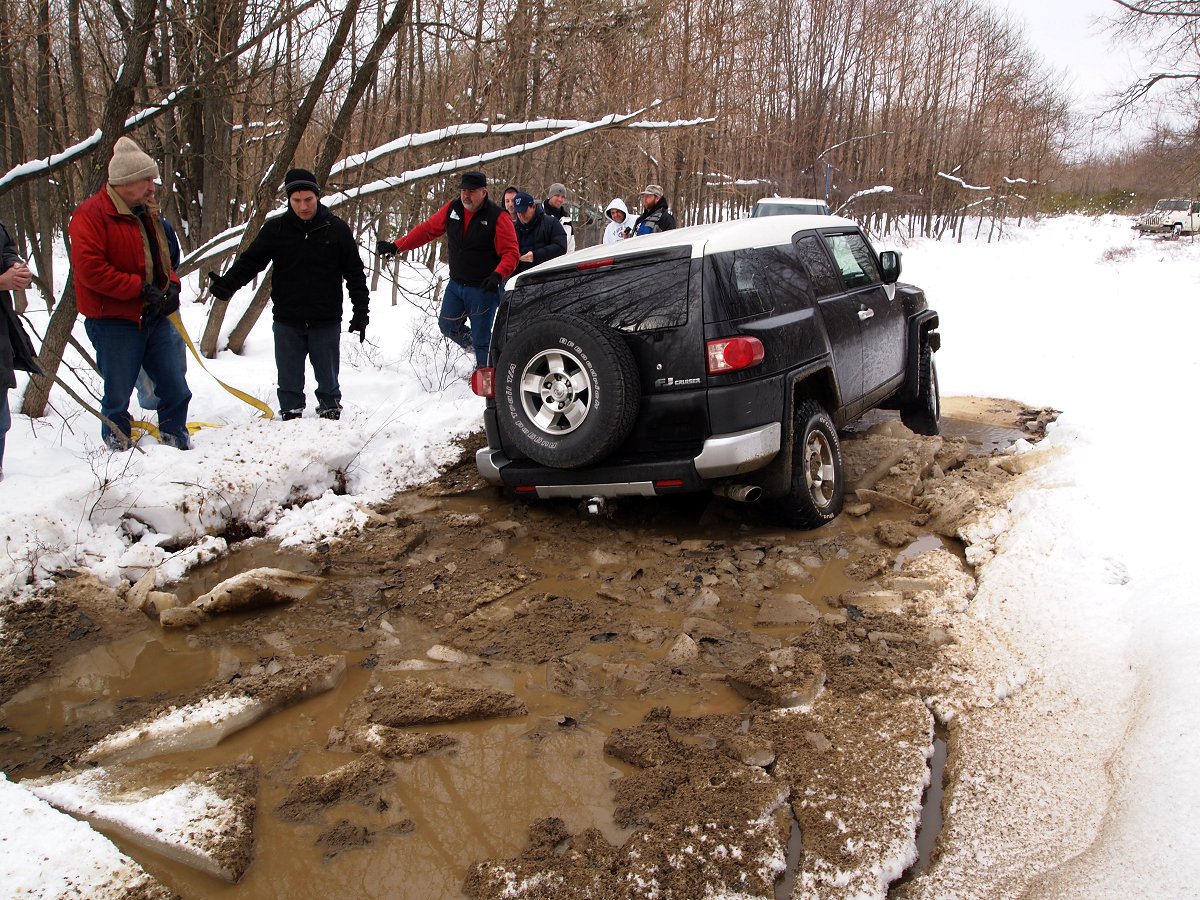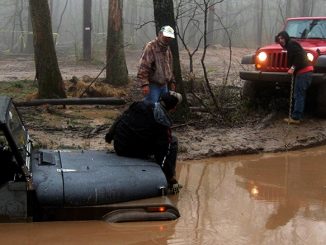
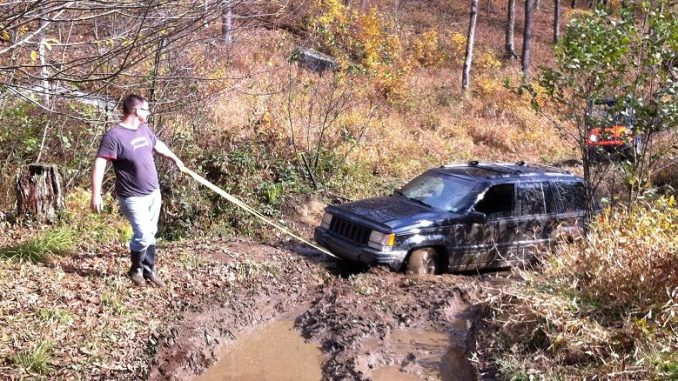
A Snatch recovery is where a bogged vehicle is recovered by using a mobile vehicle to pull the stuck vehicle free.
A Snatch recovery differs from a normal tow recovery because the line connecting the two vehicles is not tensioned prior to the recovery as in a tow recovery.
A Snatch recovery relies on the elastic properties of the strap to work properly. During a normal snatch recovery, the strap will elongate by around one meter or 3 feet.
A Snatch Strap is a nylon-webbing strap approximately 9m in length and 75mm wide with eyelets at both ends. It has a typical breaking strain in the order of 9,000 kg for a standard snatch strap. It pays to look after your snatch strap as a nick of only 1cm can reduce its breaking strain by over 50%.
The snatch recovery technique requires a second mobile vehicle and a snatch strap to perform the “snatch”.
The mobile vehicle is positioned to allow around 2m of slack in the snatch strap, while avoiding getting bogged as well. The direction of both vehicles should be lined up as straight as possible and the strap should not be twisted.
Hook the strap to a suitable vehicle tow point using shackles rated to at least 3.25 tons.
CAUTION – Never place a Snatch strap over a towball.
NEVER put the strap over a towball as it is not rated high enough and can break with fatal results (people have actually died this way).
If a towbar is the only rear point available, then remove the towball and use a rated shackle (minimum 3.25 tonne).
Some light duty towbars are unsuitable for snatch recoveries as they are not designed for the high shock loadings that a snatch recovery places on them.
For safety, you should never walk over a snatch strap once it is connected at both ends.
It is advisable to place a blanket, or similar, over the middle of the snatch strap. This will act as a ‘parachute’ if the strap or mounting points were to break.
Once the vehicles are connected and all bystanders are well out of the way (a minimum of the strap length in ALL directions), the bogged driver should signal (by hand, flashing his lights, CB etc) when he is ready.
The mobile vehicle should drive off at a steady pace (lst or 2nd low range recommended). The driver of the bogged vehicle should have the engine idling in either reverse or 1st low range (depending on the direction of tow) and as soon as the jerk from the snatch is felt, release the clutch and, hopefully, drive out.
Be careful not to run over the snatch strap as you drive off. Stop as soon as you are clear of the boggy area and remove the strap.
If this fails to extricate the bogged vehicle, repeat the process but use more speed when taking off in the mobile vehicle. Alternatively, increase the amount of slack in the snatch strap to 3m.
If the mobile vehicle cannot be placed close enough without risking bogging it as well, two snatch straps con be joined together. Place the eye of one strap through the eye of the other. Then pull the rest of the strap through its own eye. It is advisable to place a rolled up newspaper (or similar) in the loop before it is pulled too tight as this will aid undoing the two straps later.
NEVER join the straps using a shackle as this can turn into a “bullet” if either strap where to break.