
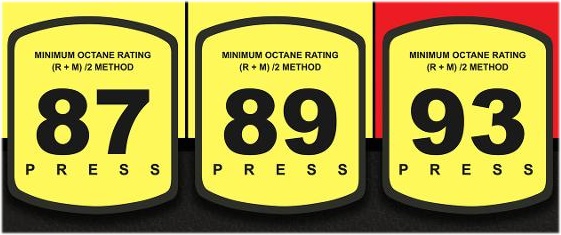
What's Octane???
Copyright ©2004 by Dan
Nguyenphuc This paper may be freely distributed, provided it is
distributed in its entirety
Last revised: May 13, 2004
Background
There's
always a lot of confusion regarding octane, octane-boosters and how
they work. Typical misconceptions are evident in blank-statements
like:
"Higher octane fuels burn slower, thus
their higher octane number"
"Higher octane fuels burn hotter, therefore more power is generated"
Higher octane fuels explodes with more force, thus their higher
power"
Both of which are untrue and
are coincidental in effect, rather than causal. In actual practice,
an engine has to be tuned specifically for high-octane fuels to
generate extra power. If you have an engine fully-tuned and
optimized for 91-octane pump gas, adding 100-octane race-gas into it
will yield little if any increase. However, if you were to take that
engine and increase the compression, advance the knock and/or
increase the boost, then you can take advantage of the higher-octane
fuel. But this precludes going back to the previous lower-octane
fuels.
Three Kinds of
Octane Boosters - 1.
ORGANO-METALLICS
There
are three primary octane-boosting additives mixed in with gasoline:
organo-metallics, ethers/alcohols and aromatics. Each one has
distinct chemical properties and results (along with side-effects)
on octane-boosting. Some people get these families of compounds and
their effects mixed up.
First, let's look at
organo-metallics which is used in the little bottles of
over-the-counter octane boosters, what makes them work and how they
compare. By far and large, these work on the same principle as
TEL-Tetra Ethyl Lead which is the principle octane-boosting
component of AvGas. For automotive OTC use, a slightly less
carcinogenic MMT compound is used (methylcyclopentadienyl manganese
tricarbonyl); it has pretty much the same structure as TEL, but with
manganese substituted for lead. These compounds have a non-linear
octane-boosting curve. The initial amounts give the most boost and
adding more gives decreasing benefits. Typically you get 3-4
'points' increase with these types of additives; going from
91-octane to 91.4 octane max. I've uploaded a comparison article of
these types of additives: 951 RacerX: Octane Booster Comparison
As
you can imagine from the metallic content, these boosters create
nasty deposits in your engine. That's why they typically include a
solvent such as mineral spirits to try and dissolve the deposits.
Then a lubricant such as ATF or Marvel Mystery Oil is typically
added to the cocktail to help your rings slide over the deposits
easier and minimize the damage. If you dyno-test a car using
organo-metallics (with straight-through exhaust), you can actually
collect metallic pellets coming out your tailpipe. Not a good thing
to be putting into your combustion chambers no less...
2.
OXYGENATES
The next group of
octane-boosting compounds are oxygenates: ethers & alcohols which
also serves an emissions purpose by bundling their own oxygen along
with the fuel. The best compound here is ethanol (CH3CH2OH) with a
115-octane (R+M)/2 rating and containing 34.73% oxygen by weight.
However, its high volatility with a RVP of 18 makes it unsuitable
for use in warm climates for emissions control. In which case, MTBE
(CH3OC(CH3)3), ETBE (CH3CH2OC(CH3)3)__ and TAME ((CH)3CCH2OCH3) are
used which has more favorable RVPs of 1.5-8.0. But they also have
correspondingly lower octane of 105-110 along with lower oxygen
content of 15.66-18.15 by weight.
Ethers
& alcohols are basically hydrocarbons fuels with an extra hydroxyl
-OH group added to one end. These fuel-additives reduce your
gas-mileage due to the displacement of hydrogen and carbon atoms by
the larger oxygen molecules. The increased molecular-mass of the
compounds with the attahced -OH is what gives the octane-boosting
effect. The -OH group also makes the compound polar, water-soluble
and highly reactive chemically. They will dissolve rubber and
plastic fuel lines and thus their concentration in fuels is fairly
limited. Thus their octane-boosting power is also reduced. Ethers
and alcohols are starting to be banned in a lot of areas because
their water-solubility makes tank leaks and dispersion by
ground-water a big problem
3.
AROMATICS
The final group of
octane-boosting compounds, aromatics show the most promise. Due to
their stable benzene-ring structures, the compounds are non-polar
and chemically stable (non-reactive). In fact, they are less
volatile and less reactive than most other hydrocarbons in gasoline.
This stability is what gives aromatics their octane-boosting powers.
Normal gasoline typically contain around 25-30% aromatics, primarily
toulene and xylene. Adding more will simply increase the octane
rating and bring their concentrations up to what you find in
higher-octane European gas (40-45% aromatics): Gasoline composition.
So
by using aromatic toluene and xylene as octane-boosters, you get
none of the bad side-effects of using organo-metallics (cancer and
engine-deposits) or ethers & alcohols (low gas-mileage and rotting
fuel-lines). By using just two gallons of xylene in a 15-gal tank of
91-octane pump gas, you've brought the octane-rating up to 94.5 and
have roughly the same aromatic content as German or French gasoline.
You may also notice in the Octane Booster Comparison article above,
that the best octane-boosting solution was to use unleaded race-gas;
the primary octane-boosting components used are toluene and xylene.
"Doesn't
higher octane fuel have higher energy content and makes more power?"
Well, it's not so simple.
Really depends upon what you mean by 'higher' and 'energy content'.
'Octane' does not directly relate to 'energy content' or 'power' in
anyway. There are many, many components and properties of gasoline
that is custom-tailored by the refinery, such as specific-gravity,
octane, oxygenates (ethers & alcohols), RVP-reid vapor pressure
(volatility), D86-distillation curve, combustion-temperature,
sensitivity, flame-front speed, VL-vapor/liquid ratio, etc. Just
about each and every one of these properties can be tailored and are
sometimes dependent, and sometimes independent upon each other.
One of the basic measures of
energy-content is BTU/gallon or Calories/gal. The
amount of heat released by any given volume of fuel is directly
related to the number of Hydrogen and Carbon atoms in that gallon.
Oxygenated fuels that use MTBE or alcohols to have extra Oxygen
onboard deliver much less energy per gallon because the oxygen atoms
are simply HUGE compared to a hydrogen or carbon. Such fuels tend to
deliver less mileage per gallon than non-oxygenated fuels. BUT, they
do not deliver less power, because that's more of a function of
air-mass ingested into the engine per 4-stroke cycle than fuel (air
is tough to cram in, fuel is simple to inject).
Compared to gasoline's
specfic-gravity of 0.751-g/cc, toluene is 0.881-g/cc and xylene
(most likely a mixture of m-xylene; o-xylene; p-xylene) is around
0.871-g/cc. This means they have more hydrogens and carbons to
combust per gallon with the O2 in the air that's being pumped
through the engine. The results of using large-percentage mixtures
of these aromatics in your fuel is a richer mixture than before with
just pure pump gas (without re-jetting). This will be safer than
using the other common additive, 100LL AvGas which is lighter than
gasoline and will result in lean mixtures and melted catalytics and
O2-sensors. (LowLead AvGas is still contains several times more
organometallics than leaded auto gasoline). I've known of several
people that have destroyed some very expensive engines because they
ran a large amount AvGas without re-tuning their air-fuel ratios.
Besides, 100LL AvGas is only about 98-MON anyway, so it's not as
effective as toluene or xylene.
Octane Doesn't
Predict...
Another factor that octane
doesn't predict is combustion temperature which may or may
not relate to the power produced. It's possible to blend two
mixtures of branched-chain paraffins along with aromatics to create
two concoctions both of which have higher octane than pump gas, and
one of them will have higher combustion temps than pump-gas, and yet
the other will have lower combustion temps.
A lot of people also confuse
octane with flame-front propagation speed which is yet
another independent factor. Take the old-days measurement of
octane-ratings with iso-octane (2,2,4-trimethylpentane) with a
octane-100 rating and n-heptane with a 0-octane rating. They both
have the exact same flame-front speed, yet one of them has a fairly
high anti-knock index. The other, n-heptane, has such low
knock-resistance that you can just tap the beaker and the stuff
would explode!
Octane Does
Predict...
In the end, all that octane
predicts is AKI-Anti Knock Index as measured on a knock
engine. These are variable-compression single-cylinder engines that
can vary their compression between about 7.0:1 to 15.0:1. There's a
highly-sensitive and accurate knock-sensor and computer hooked up to
this engine that gives a readout of knock. The engine is run with
the mystery fuel and starts at a low-compression. Then the
compression is increased gradually while knock is monitored. Various
levels of compression-ratios are used and the corresponding knock
measured. This is looked-up on standardized tables and the
MON-octane rating of the fuel is then determined. In the end, that's
ALL
that the octane predicts, is how much resistance the fuel has to
knock.
So what's the point of all
this? Just use the xylene to increase your fuel's octane-level!!!
Two to three gallons in a 15-gal tank won't change the specific
gravity by so much that it'll mess up your AF-ratios. By itself, the
resultant 96-octane mix won't automatically give you any more or
less power. But will allow you to TUNE your car for higher power by
increasing ignition advance, increasing compression or turning up
the boost!
I've accumulated a couple of
good posts on octane-blending on my RacerX website under the
Fuel-FAQ section. There's the obligatory 4-part Gasoline-FAQ,
and the F1-Rocket Fuel and DIY Octane Boosters FAQ.
Also the toxicity of xylene and toluene is
actually lower than gasoline (due to their stable ring-structures):
Toxicity Profile:
Toluene
Toxicity Profile:
Xylene
REFERENCES:
The Chemistry of Hydrocarbon
Fuels - Harold H. Schobert_ -_ Butterworth-Heinemann Ltd.
Automotive Fuels Reference Book - Keith Owen, Trevor Coley
- SAE#R151
Mixture Formation in Spark-Ignition Engines - H.P. Lenz -
Springer-Verlag
Fuel Injection - Jeff Hartman - Motorbooks International
Lean Combustion in Spark-Ignited Internal Combustion Engines
- Germane, Wood, Hess - SAE#831694
An Introduction to Thermal Fluid Engineering - Z. Warhaft
- Cambridge University Press |